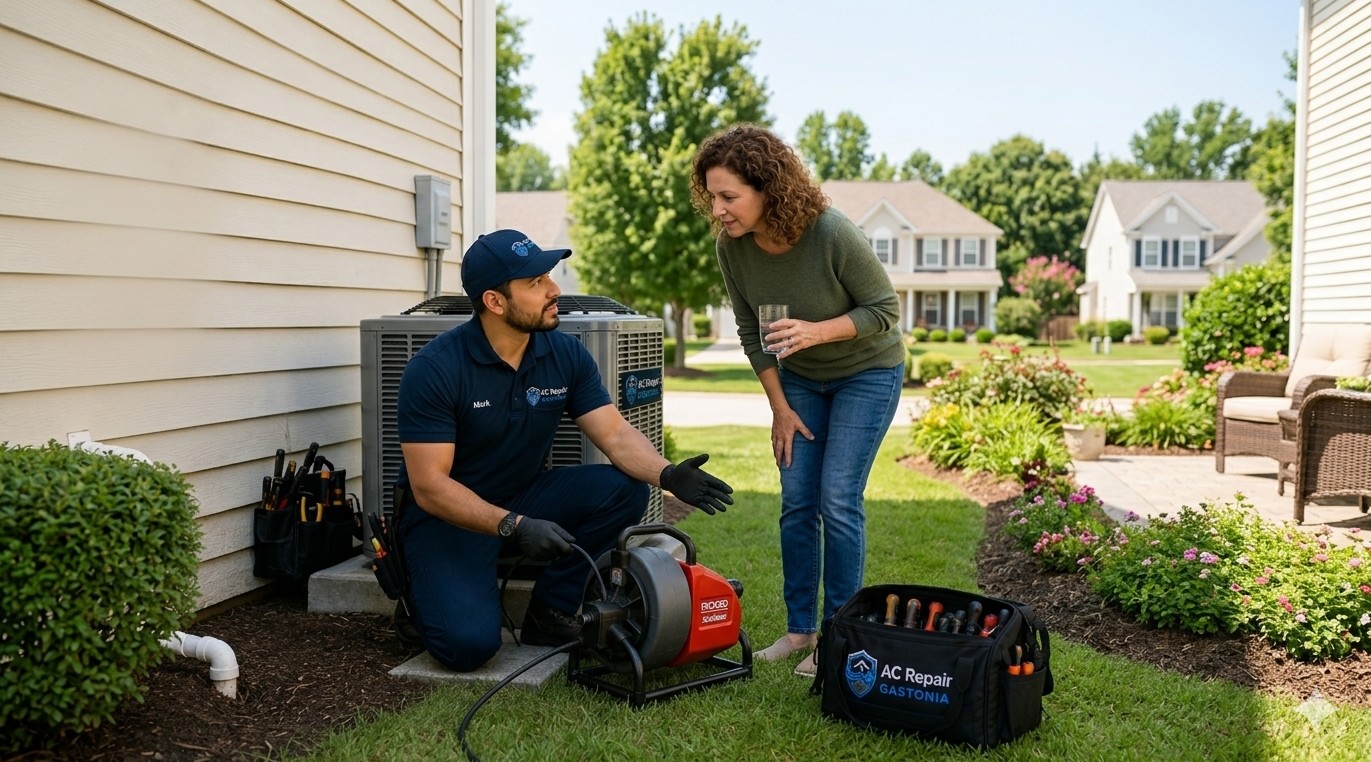
Residential AC Refrigerant Leak Specialists

Refrigerant Leak Repair in Gastonia, NC

A refrigerant leak doesn't just reduce cooling output — it puts sustained strain on the compressor and allows the problem to compound quietly over time. Gastonia AC Repair provides accurate leak detection and repair for residential AC systems, restoring dependable indoor cooling without the guesswork of a straight refrigerant recharge.
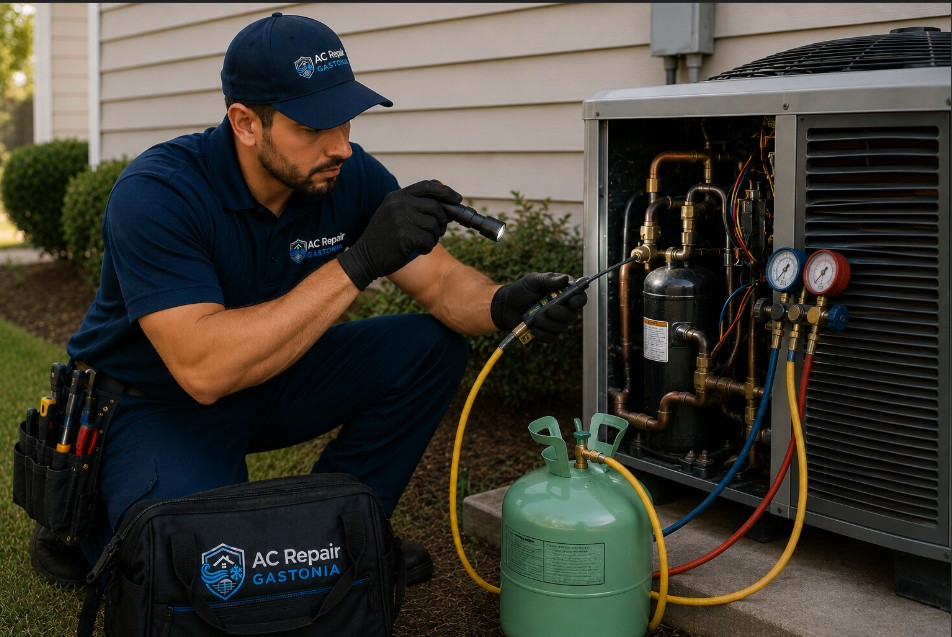
Residential Cooling Experts
Refrigerant Leak Detection
Same-Day Scheduling Available
Experienced AC Technicians

Refrigerant Leak Repair Near Me in Gastonia, NC

When a home's refrigerant leak repair in Gastonia is delayed, the system doesn't simply stop cooling — it gradually becomes less capable of reaching the temperatures it once held without effort. Longer cooling cycles, rooms that stay slightly warmer than the thermostat setting, and an AC that runs consistently without ever fully satisfying are the quiet signs that the refrigerant charge is low. Gastonia AC Repair treats the source of the loss before anything else — because recharging without finding the leak is a temporary measure that returns as the same problem within a season.

Residential AC systems in Gastonia face particularly demanding conditions during warmer months — high ambient temperatures combined with humidity mean a system that's even marginally low on refrigerant will struggle noticeably where a dry-climate system might not. Identifying and repairing the leak restores dependable, consistent cooling rather than buying time until the next service visit.

Gastonia Residential
Seasonal Cooling Performance
Root Cause Before Recharge
Refrigerant Leak Repair — Gastonia, NC

Signs Your AC May Have a Refrigerant Leak
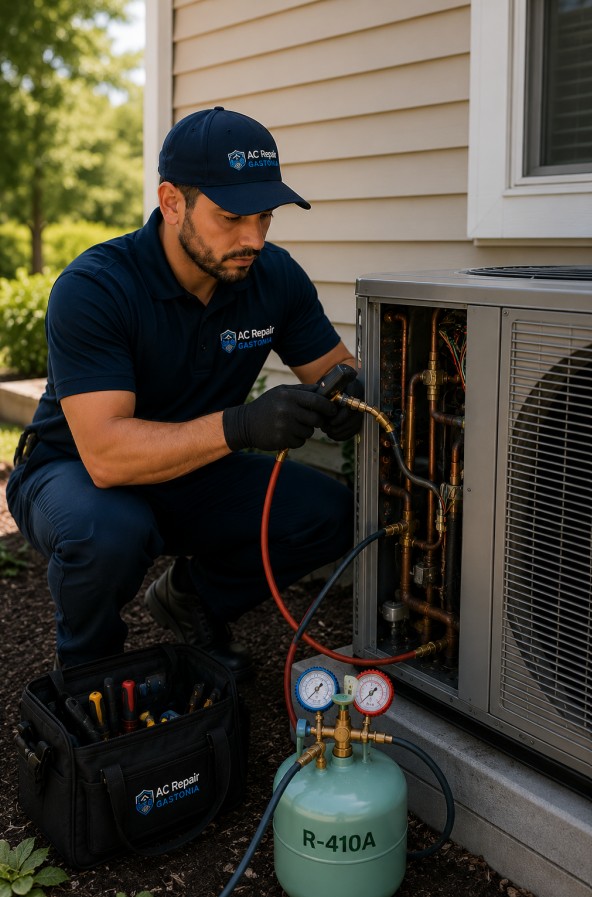
Warm Air from Supply Vents

The most direct sign — air blowing from vents that feels room-temperature or only slightly cool. The system runs a full cycle but the air it delivers never drops to a comfortable temperature, regardless of how low the thermostat is set.

Performance

Longer Than Normal Cooling Cycles

A system low on refrigerant has to run much longer to approach the set temperature — and often never fully reaches it. Cycles that used to last 10–15 minutes stretch to 30 or more while the home stays warmer than expected, especially during Gastonia's humid summer afternoons.

Performance

Ice Buildup on the Refrigerant Lines

Visible ice or frost forming on the copper refrigerant lines near the indoor unit is a clear sign of a refrigerant issue. Low charge causes the remaining refrigerant to absorb heat unevenly, dropping line temperatures below freezing even as the room stays warm. A frozen evaporator coil often accompanies this symptom.

Structural

Rising Indoor Humidity

Central AC removes moisture as it cools. A refrigerant-depleted system loses dehumidification capacity before it loses cooling entirely — so the first sign is often air that feels heavy and close even when the temperature reads near the set point.

Comfort

Cooling Performance That Fades Gradually

Unlike a capacitor failure that stops a system suddenly, refrigerant leaks degrade performance slowly. A home that was comfortable last summer but noticeably warmer this year — with no other changes — often points to a slow, continuous refrigerant loss that Gastonia AC Repair can isolate and correct.

Comfort

System Runs Continuously Without Satisfying

When a system runs without cycling off — or cycles off only briefly before restarting — it signals the refrigerant charge can no longer support efficient heat exchange. Continuous operation accelerates compressor wear and raises energy costs without improving comfort.

Performance

These symptoms overlap with other AC problems, which is why accurate leak detection comes before any refrigerant recharge. Gastonia AC Repair identifies the source of loss and repairs it — not just restores the charge level until the next service visit.

Refrigerant Leak Repair — Gastonia, NC

What Causes Refrigerant Leaks?

Refrigerant leaks rarely have a single obvious cause. In residential AC systems, loss develops gradually through component wear, material stress, and environmental exposure — often over several seasons before any performance change is noticed.

01 Chemical

Evaporator Coil Corrosion

The evaporator coil is the most common site of refrigerant loss in residential systems. Formicary corrosion — a chemical reaction between copper tubing, moisture, and volatile organic compounds present in indoor air — creates microscopic pinholes in the coil over time. These openings are too small to detect visually but allow refrigerant to escape continuously. Homes with new construction materials, cleaning products, or certain adhesives off-gassing indoors are particularly susceptible.

02 Mechanical

Vibration Wear on Refrigerant Lines

Every cooling cycle produces vibration through the compressor and fan motors. Over years of operation, refrigerant lines that make contact with cabinets, brackets, or other components develop wear points from this repeated motion. The copper softens and eventually develops a crack or pinhole at the friction point — a cause that's entirely mechanical and entirely predictable in systems that weren't properly secured during installation.

03 Mechanical

Aging Flare Connections and Fittings

Flare connections — where copper refrigerant lines join the indoor and outdoor unit — rely on precise metal-to-metal sealing. Over time, thermal expansion and contraction from seasonal temperature changes cause these joints to loosen slightly. A connection that was properly tight at installation may develop a slow leak after 8–12 years without the fitting ever being mechanically disturbed. This is among the most common causes of gradual refrigerant loss in systems beyond their first decade of service.

04 Mechanical

Pressure Stress from Short Cycling

AC systems that short cycle — starting and stopping rapidly rather than completing full cooling runs — subject the refrigerant circuit to repeated high-pressure surges. Each startup spike stresses connections, valves, and coil joints in ways that sustained operation does not. A system that has been short cycling for one or two seasons will often develop refrigerant loss at the weakest point in the circuit, which may be different from where a leak would be expected in a normally operating system. Gastonia AC Repair traces the actual loss point rather than assuming its location.

05 Environmental

Outdoor Unit Corrosion and Environmental Exposure

The outdoor condenser unit is exposed to rain, humidity, temperature extremes, and in some cases, airborne chemicals from fertilizers, pesticides, or nearby industrial sources. Over time, condenser coil fins and the outdoor refrigerant connections can develop corrosion that compromises the sealed refrigerant circuit. Gastonia's warm, humid summers accelerate this process compared to drier climates — making outdoor unit inspection a meaningful part of any compressor and refrigerant system evaluation.

06 Compound

Operation Under Low Charge — a Compounding Factor

When a system runs with insufficient refrigerant, the compressor works beyond its normal operating range to compensate — increasing internal temperatures and pressures. This creates a compounding cycle: the original leak causes conditions that accelerate wear at other points in the circuit, making a second or third leak site more likely the longer the low-charge condition continues. This is why prompt diagnosis matters more than the complexity of the initial leak suggests.

Finding the leak source is more important than correcting the charge level. Refrigerant added to a system without repairing the loss point returns as the same problem — Gastonia AC Repair locates and seals the leak before any recharge is performed.

Diagnosis First
Refrigerant Leak Repair — Gastonia, NC

Why Refrigerant Leaks
Should Be Repaired Early

A refrigerant leak doesn't immediately disable a cooling system — it degrades it gradually. Each week a leak goes unaddressed, the system works harder to compensate for declining refrigerant charge, creating a sequence of compounding effects on components, efficiency, and reliability.

Cooling Performance

Reduced Cooling Efficiency

Refrigerant is the medium through which your AC transfers heat out of the home. As charge drops below the manufacturer's specified level, the system's ability to absorb heat from indoor air diminishes. The home takes longer to reach the set temperature, and during Gastonia's warm afternoons, the system may run continuously without ever fully satisfying the thermostat. This inefficiency is often the first sign homeowners notice — and it only worsens as the charge continues to decline.

System Demand

Longer and More Frequent Run Cycles

A system compensating for low refrigerant runs longer to achieve the same cooling output. This means the compressor, blower motor, and condenser fan are all operating for more hours per day than the system was designed to sustain. Extended runtime accelerates wear across every mechanical component — not just the compressor — and increases energy consumption noticeably within one or two billing cycles.

Component Risk

Evaporator Coil Ice Formation

Low refrigerant causes the evaporator coil to drop below freezing even while the system is running in warm conditions. Ice forms on the coil surface, progressively blocking airflow and heat exchange — a frozen coil can cause water damage when it thaws, and running the system while frozen risks sending liquid refrigerant back to the compressor, which causes permanent damage to internal compressor components.

Compressor Health

Increasing Strain on the Compressor

The compressor is designed to operate within a specific suction pressure range. Low refrigerant forces it to operate below that range — running in conditions that cause it to work harder, run hotter, and lubricate its internal parts less effectively. Sustained operation in this state is one of the most common causes of premature compressor failure in residential systems — a repair that costs substantially more than addressing the original refrigerant leak.

System Risk

Eventual Loss of Cooling Reliability

As refrigerant charge continues to decline and system components absorb compounding strain, the probability of a complete cooling failure increases. A system that was mildly inefficient in May can reach a point where it stops cooling entirely by mid-July — exactly when Gastonia homeowners depend on it most. Addressing a refrigerant leak at the first sign of performance decline prevents the entire cascade above from developing. Gastonia AC Repair finds and repairs the refrigerant leak before recommending any recharge — so the repaired system holds, not just recovers temporarily.

Gastonia AC Repair

Every refrigerant repair starts with locating the source of the leak. Recharging without finding and sealing the leak produces a system that declines again within weeks — not a repair, just a delay.

For homes with central AC, the same diagnostic standard applies across every component.
Refrigerant Leak Repair — Gastonia, NC

Our Refrigerant Leak Detection Process

Every refrigerant leak repair in Gastonia starts the same way — with a complete system evaluation before any work is recommended. Here's how Gastonia AC Repair approaches each call.

Cooling Performance Evaluation

We begin with a full performance check — measuring actual temperature drop across the coil and comparing it against system specifications. This tells us how far below design capacity the system is operating before we open anything.

Pressure Testing

We test the system's refrigerant pressure on both the high and low sides. Pressure readings outside manufacturer range confirm a charge issue and help narrow the location and type of leak before any visual inspection begins.

Leak Source Detection

We inspect refrigerant lines, coil connections, Schrader valves, and the evaporator coil for signs of oil residue, corrosion, or physical damage. Electronic leak detection is used where the source is not visually apparent.

Repair & Seal

Once located, the leak source is repaired or the affected component is replaced. Recharging begins only after the system passes a pressure hold test — confirming the repair sealed before any EPA 608-regulated refrigerant is added.

Performance Verification

After recharge, we verify the system is cooling at the correct temperature differential and that the compressor is cycling properly. You receive a written record of the repair and the post-repair performance readings.

Once the leak source is confirmed, every homeowner receives a clear explanation and a written quote before any repair begins. If the leak is small and accessible — a Schrader valve, a line fitting, or a minor coil connection — it is typically repaired in the same visit. Larger coil leaks or line failures may require additional component work, which we communicate clearly with a timeline and cost estimate upfront.

For homes where the compressor has already been damaged by extended low-refrigerant operation, the diagnosis will identify that separately — so you understand the full picture before committing to a refrigerant recharge that wouldn't restore normal cooling. Gastonia AC Repair doesn't recharge a system that won't benefit from it.

What Every Refrigerant Leak Repair Includes

Full system pressure test — both high and low sides

Written diagnosis and repair quote before any work starts

EPA 608-certified refrigerant handling and recharge

Post-repair performance verification and written service record

Refrigerant Leak Repair — Gastonia, NC

Why Homeowners Choose
Gastonia AC Repair

The Difference Is in the Diagnosis.

Most homeowners who call Gastonia AC Repair for AC refrigerant leak repair in Gastonia have already had at least one prior service visit where the system was recharged without the leak being found. The cooling returned for a few weeks, then declined again. We approach every refrigerant call differently: the leak source is confirmed and sealed before any refrigerant is added — not after, and not alongside a recharge that buys temporary performance.

That approach takes longer on the first visit. It requires more thorough inspection, better equipment, and a technician who understands that a recharge without a repair is not a repair. For homeowners dealing with central AC systems where refrigerant issues compound other performance problems, this standard is what determines whether the repair lasts through the season or requires another call in six weeks.

Service Record
4.9

Google rating from verified reviews

— 380+ Gastonia homeowner reviews
98%

First-visit repair completion rate

— across all residential repairs
15+ yrs

Serving Gaston County residential homes

— NC Licensed · EPA 608 Certified

The Leak Source Is Found Before Work Begins

We locate and confirm the source of the leak — using pressure testing and electronic detection where needed — before writing a repair recommendation or touching the refrigerant charge. Recharging without finding the source is the most common reason a refrigerant repair doesn't hold.

A Written Quote Before Any Work Starts

Every refrigerant leak repair in Gastonia that Gastonia AC Repair handles includes a written diagnostic finding and repair quote that the homeowner approves before any work begins. No surprises, no add-ons discovered after the fact.

Plain-Language Communication Throughout

What was found, what it means for the system, and what the repair involves — explained in language that makes sense to a homeowner, not a technician. You don't need to understand HVAC to understand your repair. We make sure of that before we leave.

Performance Verified Before the Visit Ends

After the leak is sealed and the system is recharged, we test cooling performance — temperature drop across the coil, compressor cycle behavior, and airflow output. You receive a written service record of the repair and the post-repair readings before the technician leaves your home.
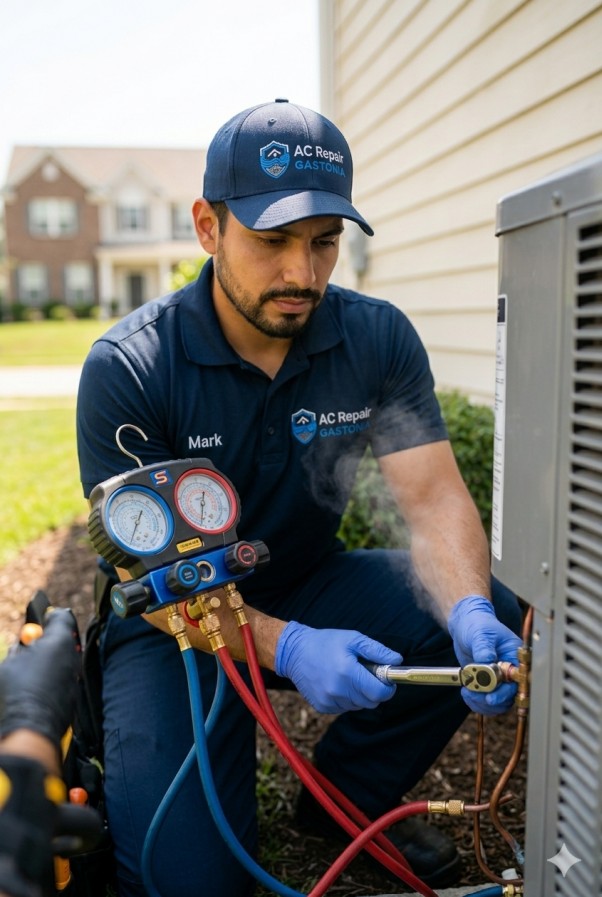
AC Repair gastonia expert repairing refrigerant leak

"I'd had the refrigerant topped up twice in two years by two different services. Same result both times — cool for a month, then warm again. Gastonia AC Repair found a pinhole leak in the evaporator coil, sealed it properly, and recharged the system. That was two summers ago. It's been cooling perfectly ever since. Should have called them first."

R. Holloway  ·  Gastonia homeowner

Refrigerant leak repair near me in Gastonia should mean a repair that lasts — not a recharge that buys a few more weeks of cooling. That's the standard Gastonia AC Repair holds every call to.

Refrigerant Leak Repair — Gastonia, NC

Refrigerant Leak
Repair FAQs

How do I know if my AC has a refrigerant leak?

The most common signs are warm or room-temperature air from the vents despite the system running, a system that takes noticeably longer than usual to cool the home, and ice forming on the indoor coil or refrigerant lines. In some cases a faint sweet or chemical smell near the indoor unit is present, but many refrigerant leaks produce no odor at all. The most reliable confirmation is a pressure test by a certified technician.

Can refrigerant leaks be repaired permanently?

Yes — most refrigerant leaks can be permanently repaired. Small leaks at Schrader valves, fittings, and accessible line connections are sealed directly and hold reliably long-term. Larger evaporator coil leaks may require coil replacement depending on the extent of the corrosion or damage. The key is locating the exact source before recharging — a recharge without a seal is temporary by definition.

Is refrigerant added before or after the leak is repaired?

After — always. Recharging before sealing the leak means the refrigerant will escape through the same path it came from, putting the system back to the same condition within weeks. Gastonia AC Repair recharges only after the repair is confirmed sealed by a pressure hold test, which verifies the system maintains pressure over time before any EPA 608-regulated refrigerant is added.

Why is my AC freezing up?

Ice forming on the indoor coil is most commonly caused by low refrigerant or restricted airflow — both of which cause the coil surface temperature to drop below freezing. Running a frozen system risks liquid refrigerant reaching the compressor, which causes internal damage. If you see ice on the coil or refrigerant lines, turn the system to fan-only mode and request a diagnostic visit before restarting it in cooling mode.

Can a refrigerant leak damage the compressor?

Yes — this is one of the most important reasons to address a refrigerant leak early. Operating with low refrigerant forces the compressor to run at lower-than-normal suction pressure, which causes it to work harder, run hotter, and lubricate its internal components less effectively. Sustained operation in this state leads to compressor damage that may require a significantly more expensive repair than the original refrigerant leak.

Can low refrigerant affect how long the AC runs?

Yes. When refrigerant charge is below the system's design specification, each cooling cycle removes less heat from the home — so the system runs longer to compensate. During warmer weather, a home that might normally cool in 20 minutes can take 45 minutes or more with low refrigerant. Extended runtime directly increases wear on the compressor, blower motor, and condenser fan across every additional operating hour.

Can a refrigerant leak come back after it's been repaired?

A properly repaired and sealed leak at a specific location should not return at that same point. However, a system with formicary corrosion on the evaporator coil — common in homes with certain air quality conditions — may develop additional small pinholes over time at different locations on the same coil. If the coil has extensive corrosion, coil replacement may be a more cost-effective long-term solution than repeated repairs. Gastonia AC Repair advises on that honestly during the diagnostic visit.

Have a question not covered above? Reach out to Gastonia AC Repair before scheduling — we'll give you a straight answer about your specific situation before you commit to a service visit.

Gastonia AC Repair
Gastonia AC Repair

Schedule Refrigerant Leak Repair in Gastonia

If your system is taking longer to cool, running continuously, or performing inconsistently — a refrigerant issue may be the cause. Gastonia AC Repair diagnoses the source of the leak, seals it properly, and recharges the system only after the repair holds. Most refrigerant leak repair visits are completed the same day with a written quote provided before any work begins. For homes with central AC, the same thorough diagnostic standard applies to every component we assess.

EPA 608 Certified Same-Day Availability Written Quote First NC Licensed
Scroll to Top