Cherryville, NC  ·  18 Miles from Gastonia  ·  Licensed & Certified

AC Repair in Cherryville, NC

Cherryville sits at the western edge of Gaston County — 18 miles from our Gastonia base via US-74 W. We dispatch to Cherryville as a regular part of our western county route, not as an occasional extension. When you call, a licensed technician arrives prepared to diagnose and repair, not just assess and reschedule.

Every service call works the same way: we find the cause first, explain what we found in plain terms, and provide a written estimate before any work begins. If repair makes sense, we'll fix it. If it doesn't, we'll tell you why — and what a better path looks like.

18 Miles via US-74 W  ·  Licensed HVAC Contractor  ·  Certified

Same-Day Response
Licensed & Insured
Written Estimate First
18mi From Gastonia
98% First-Visit Fix Rate
~47min Avg. Response Time
Cherryville, NC  ·  Western Gaston County  ·  ~18 Miles via US-74 W

How We Reach Cherryville — and What That Means for Your Service Call

Cherryville is the furthest west of the communities we serve regularly in Gaston County. From our Gastonia base, the route follows US-74 W and takes around 25 to 30 minutes of drive time under normal conditions. Our average door-to-door response across all Gaston County calls runs approximately 47 minutes from the time you call to when a technician is at your address — that figure includes dispatch, not just drive time.

Cherryville homeowners sometimes look toward Kings Mountain or Shelby contractors because those feel geographically closer. If you live in the western part of Cherryville near the Cleveland County line, that instinct isn't wrong. But there's a practical difference worth knowing: a contractor licensed in North Carolina and based in Gaston County carries insurance coverage and licensing relevant to residential work in this county. That matters when something goes wrong with work done on your home. We serve Cherryville on an active route — you're not being routed to an overflow crew.

Every technician we dispatch is licensed, certified for refrigerant handling, and fully insured for residential work. Before any repair starts, you receive a written estimate with a stated price — not a range, not an estimate that adjusts after the work is done. If the diagnosis turns up something unexpected mid-repair, work stops, you're told what changed and why, and a revised estimate is presented before anything continues.

One note on scheduling: same-day service in Cherryville depends on current route load and call volume. When same-day availability allows, we confirm your arrival window before ending the call. When it doesn't, we're upfront about that too — and about when the next available window actually is.

Cherryville, NC — 18 Miles via US-74 W from Gastonia Licensed HVAC Contractor · Certified Workmanship Guarantee — All Repairs

Your AC Is Telling You Something — Here's What the Signs Usually Mean

Most AC problems don't appear suddenly. There's usually a period — sometimes days, sometimes weeks — where the system is working harder than it should and showing small signs that something is changing. In Cherryville homes, where a large share of the housing stock has been through 20 or more cooling seasons, those signs are worth paying attention to earlier rather than later.

01 / 06

The system runs constantly but the house doesn't cool down

This is one of the most common calls from Cherryville homeowners during peak summer weeks. The system is on, the air is moving, but temperatures creep up through the afternoon instead of holding steady. Usually this points to something affecting the system's ability to transfer heat — a refrigerant issue, dirty coils, or a compressor working at reduced capacity. It can also mean the system is simply too small for the load it's carrying, which becomes more obvious during hotter-than-usual stretches.

02 / 06

Ice forming on the refrigerant lines or the indoor coil

Ice on an AC system sounds counterintuitive but it's a reliable signal that airflow or refrigerant levels are off. When the coil gets colder than it should — because not enough air is moving across it, or because the refrigerant charge is low — moisture in the air freezes on the coil surface. Continuing to run the system in this condition puts added stress on the compressor. Turning the system off and letting it thaw is the right first step; diagnosis is needed before running it again.

03 / 06

A new or worsening noise from the system

New noise almost always means a component has started degrading. Rattling near the outdoor unit may be loose hardware. Grinding or squealing from the air handler often points to motor bearings. A clicking sound that doesn't stop after startup is worth checking immediately — it frequently indicates a relay or contactor fault. The type of noise usually narrows down the general area of the problem before any tools come out.

04 / 06

Certain rooms won't cool regardless of where the thermostat is set

Uneven cooling in a home is often a combination problem — part equipment, part duct, part airflow. In Cherryville homes with older ductwork, partial blockages or separated connections in the duct system can reduce airflow to rooms at the far end of a duct run without affecting rooms closer to the air handler. This is different from a compressor or refrigerant problem, and gets misdiagnosed when a technician replaces parts before checking airflow distribution.

05 / 06

Short cycling — the system turns on, runs briefly, and shuts off

A cycle that starts and stops every few minutes instead of running to completion is called short cycling. It places repeated startup strain on the compressor and usually points to one of a few causes: a thermostat losing calibration, a refrigerant charge issue, or an electrical fault in the control circuit. Some oversized systems also short-cycle by design — they cool too quickly, satisfy the thermostat before completing a full dehumidification cycle, and leave the home feeling clammy even at the right temperature. Diagnosis identifies which of these applies.

06 / 06

Your utility bill climbed without any change in how you use the system

Duke Energy bills that increase during months where your usage habits haven't changed almost always reflect a system working harder to produce the same result. Dirty coils, restricted airflow, and declining refrigerant charge all reduce efficiency — the system runs longer each cycle to reach the set temperature, and those extra run minutes show up in the bill before cooling noticeably degrades. It's an early warning sign worth acting on before the system starts struggling visibly.

Any of these signs warrants a diagnostic call — not because every sign means a major repair, but because diagnosing the cause early usually costs less than diagnosing it after a more serious failure. A written estimate follows the diagnosis so you know the actual cost before anything is approved.

Schedule Service
Same-Day Response Available
Written Estimate Before Work Begins
Licensed
Insured

Common AC Problems We Fix in Cherryville, NC

Gaston County's hot, humid Piedmont summers put real seasonal demand on residential AC systems. After years of cooling cycles, specific components wear in predictable ways. Understanding what's actually failing — not just what's symptomatic — is what separates a lasting repair from an unnecessary part swap.

The electrical failures we see most often in Cherryville — capacitor failures, contactor wear, and relay faults — tend to cluster in systems that have been through a decade or more of western Gaston County summers. Capacitors degrade with thermal cycling, and the hot, humid stretch from June through September accelerates that process. A capacitor that's weakening may show as intermittent cooling or sluggish startup before it fails completely. Testing a capacitor is a first-step diagnostic task, not a guesswork replacement.

Contactors wear differently than capacitors — instead of gradual degradation, a pitted or corroded contactor often creates erratic behavior. The outdoor unit may fail to start, start then immediately shut off, or hum without turning over. Short cycling is a frequent result, and each failed startup adds mechanical stress to the compressor. On systems that have been running for several seasons without inspection, both the capacitor and contactor are worth checking as a diagnostic pair rather than in isolation.

Refrigerant levels are where assumptions frequently create problems. Low refrigerant doesn't happen from normal operation — when levels are down, something has leaked. The right fix is finding the leak, repairing it, and then recharging the system. Adding refrigerant without addressing the source means the new charge will leak too, usually on the same schedule as the original.

Compressor problems in Cherryville calls are most often the result of upstream issues that went unrepaired through one too many cooling seasons. A refrigerant charge that's been low for two or three seasons puts the compressor under thermal stress it wasn't designed to handle. Restricted airflow does the same thing over a longer time horizon. Compressor repairs are among the more involved jobs in AC service, which is why the diagnostic conversation about whether repair or replacement makes more sense tends to be longer — and more important to get right.

Condensate drain issues are easy to overlook because they don't affect comfort directly — until they do. When the drain line backs up, the system's safety float switch may shut the unit off entirely, which homeowners sometimes interpret as an electrical or compressor failure. A backed-up drain is the right thing to rule out early in any diagnostic that involves a system that shut itself off without obvious cause. Clearing it is straightforward when caught before water has reached surrounding materials.

Airflow problems and component wear interact in ways that are worth understanding. A dirty filter restricts the air moving across the evaporator coil. That reduced airflow raises the chance of coil icing, which causes the compressor to run under conditions it wasn't designed for, which accelerates wear on the capacitor and contactor that power it. Problems in AC systems rarely appear in isolation — the diagnostic process matters because it traces the chain, not just the most visible link.
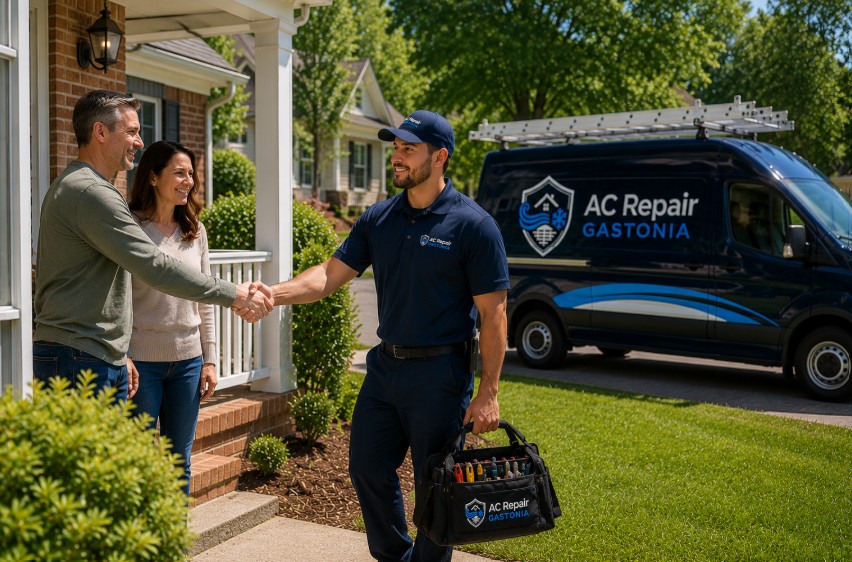
Homeowner greeting an HVAC technician at the door with a handshake as the technician arrives carrying a tool bag for an AC repair service call in Cherryville, NC
Capacitor Failures

Stores electrical energy to start and run motors. Gradual failure causes intermittent or no cooling.

Contactor Problems

Electrical switch for the outdoor unit. Worn contacts cause short cycling and added compressor stress.

Low refrigerant means a leak is present. Results in warm air and frozen coils until the source is repaired.

The heart of the cooling system. Often stressed by upstream airflow or refrigerant issues left unresolved.

Algae and debris block condensate drainage, causing water to back up near the indoor unit.

Airflow Restrictions

Dirty filters, blower faults, and blocked vents reduce comfort and accelerate component wear.

Aging Components

Motors, relays, and electrical connections wear across seasons. Inspection identifies what's failing before it fails completely.

Cherryville, NC · Gaston County
Certified · Licensed
Same-Day Response Available

AC Not Cooling in Cherryville? Here's What It Usually Means

If your system is running but the house still feels warm, the unit is telling you something. A running AC that isn't cooling is one of the most common calls we receive from Cherryville homeowners in a typical Cherryville summer — and it usually points to one of a handful of diagnosable causes. Gaston County's hot, humid Piedmont summers put real pressure on cooling systems, and that pressure tends to surface issues that have been developing quietly for weeks. Learn more about AC not cooling properly and what to expect from a proper diagnosis.

Refrigerant is what absorbs heat inside your home and releases it outdoors. It doesn't deplete on its own — low refrigerant means there's a leak somewhere in the system. You'll notice the air at your vents feels less cold than it should, and the system runs longer trying to reach the set temperature. The fix isn't adding more refrigerant — it's finding and sealing the leak first.

Dirty Evaporator or Condenser Coils

Your AC transfers heat through its coils. When those coils are coated in dust, debris, or grime, heat transfer becomes less efficient and the system works harder to compensate. In Gaston County's humid summers, coil buildup is a common contributor to reduced cooling capacity and higher energy use.

Restricted Airflow

A clogged filter, blocked return vent, or failing blower motor can significantly reduce the amount of air moving through your system. The result is often uneven cooling room to room — some spaces feel fine, others stay warm. Airflow restrictions also put added strain on other components over time.

Ice forming on your indoor coil is a symptom, not a root cause. It usually points to low refrigerant or severely restricted airflow — both of which drop the coil's surface temperature below freezing. Thawing the coil without addressing the underlying issue means it will freeze again. Proper diagnosis identifies what caused it.

Compressor Strain

The compressor drives the entire cooling process. When smaller problems — low refrigerant, coil buildup, restricted airflow — go unaddressed through a Piedmont summer, the compressor absorbs that extra stress. Compressor repairs are among the more involved and costly, which is why catching upstream issues early matters.

Many of these causes share similar symptoms. The house feels warm. The system runs but doesn't seem to make progress. Some rooms cool while others don't. Similar symptoms don't always mean the same problem — which is why working through a checklist on your own often leads to parts being replaced before the actual cause is identified.

What makes a proper diagnosis useful is that it traces the symptom back to the actual failing component. A refrigerant issue requires leak detection and repair before recharging. A frozen coil requires understanding why the coil froze. Treating the symptom without addressing the source tends to shorten the life of other components and often leads to a repeat service call within the same season.

Gaston County homes that have been through several cooling seasons often show wear across more than one component at a time. A same-day diagnostic visit in Cherryville gives you a clear picture of what's failing, what's showing early signs of wear, and what the most effective repair path looks like — before the next stretch of 90-degree weather arrives.

98% of repairs are completed on the first visit. That figure holds because diagnosis happens before parts are ordered — not after. Identifying the actual cause on-site means the right repair happens the same day.
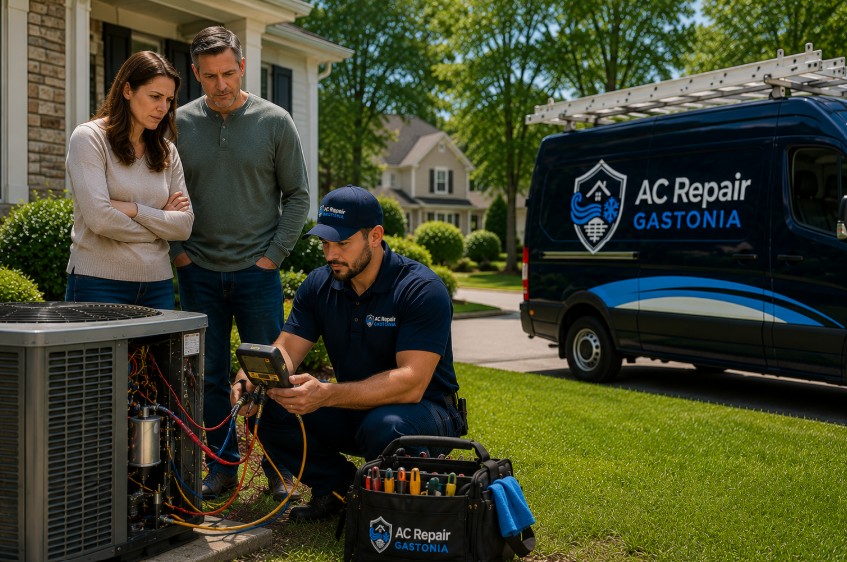
HVAC technician crouched beside the outdoor AC unit, removing the panel and checking the wiring while trying to figure out why the system isn't cooling properly at a Cherryville home
Written Estimate Provided
No Pressure Explanation
Licensed · Fully Insured
Cherryville & Gaston County

Emergency AC Repair
in Cherryville, NC

When your AC stops working in the middle of a Gaston County summer, the situation doesn't wait. Whether the system won't start at all, is pushing warm air, keeps shutting off, or something smells or sounds wrong — those are the calls we respond to the same day. Emergency AC repair in Cherryville follows the same process as every other area we serve: a technician on-site, a diagnosis completed, and a clear explanation of what's happening before anything is touched.
~47 min
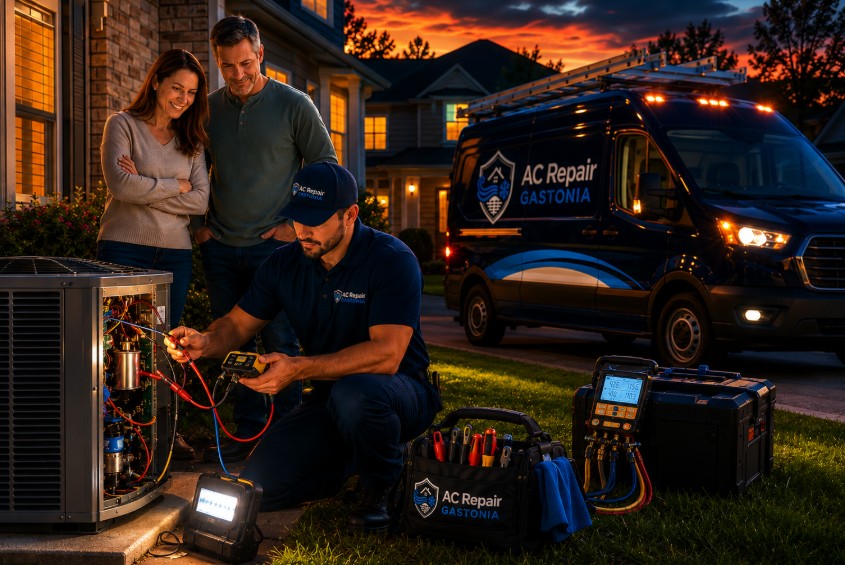
HVAC technician working on the outdoor AC unit in the evening during an emergency repair at a Cherryville home, with the homeowner standing nearby watching the repair in progress

When to Call

  • AC has completely stopped running
  • System runs but only pushes warm air
  • Unit cycles on and off repeatedly
  • Burning smell or electrical odor
  • Loud banging, grinding, or rattling
  • Water pooling around the indoor unit

Any of these warrants a same-day call. Some, like electrical smells or water near the air handler, are better addressed quickly before the problem compounds.

How We Respond

When a technician arrives at your Cherryville home, the first step is always diagnosis. You'll receive a clear explanation and a written estimate before any repair work begins. That process doesn't change based on how urgent the situation is.

A same-day call gets the same diagnostic rigor as any scheduled visit. The goal is an honest picture of what's failing and what it takes to fix it — not a rushed repair that brings you back to the same problem weeks later.

Cherryville Service

Cherryville is 18 miles from our Gastonia base via US-74 W — further than most of the communities we serve. We account for that in how we manage the western county dispatch schedule. When you call for emergency service, you receive a clear arrival window based on actual current technician location, not a best-case drive estimate.

The diagnostic and estimate process doesn't change based on distance or urgency. A technician arrives, evaluates the system, and explains what's wrong before any work begins. That's true at 2 PM on a Tuesday and equally true at 7 PM on the hottest day of July.

Cherryville, NC · Gaston County
Same-Day Response
Licensed · Certified

How Cherryville's Housing Mix
Shapes What Repairs Look Like

Cherryville has grown in layers over more than a century, and those layers show up in what we find on service calls. A home near downtown dates to a different era than a ranch-style subdivision home from the 1980s, which differs again from a newer build along Moss Lake. The age and type of a home don't determine what's wrong with the AC — but they do pattern what's most likely to be wrong, and a technician who recognizes those patterns gets to the right diagnosis more efficiently.

Era 1920s – 1960s

Historic Downtown & Established Neighborhoods

Homes built in and around Cherryville's original residential core — including areas near downtown and older subdivisions that date to the mid-20th century — often have equipment that is 20 or more years old. Some of it is running on R-22 refrigerant, which stopped being manufactured in the US in 2020.

On calls at homes like these, we identify refrigerant type before any work involving the refrigerant circuit — because the cost and repair calculus for an R-22 system is different from a current-refrigerant system. Ductwork in these homes frequently runs through unconditioned attic or crawl space, which matters for both duct integrity and system efficiency.

Era 1970s – 1990s

Ranch Subdivisions

The ranch-style subdivisions that fill Cherryville's residential areas between the downtown core and the city's outskirts represent the largest share of homes we service here. Equipment in these homes often sits in the 15–25 year range — old enough to show predictable wear patterns, but not always old enough to justify automatic replacement.

Capacitors and contactors are the most frequent repair items on this generation of equipment. Blower motors and refrigerant-side components follow. Ductwork tends to be flex duct in unconditioned crawl spaces — the same crawl space conditions that cause comfort problems in far rooms are worth noting during a diagnostic call.

Era 2000s – Present

Newer Homes & Moss Lake Area

Newer construction on Cherryville's outskirts and homes along Moss Lake west of the city present a different profile. Equipment in these homes tends to be less than 15 years old, often still under manufacturer warranty coverage for major components. Service calls here are more likely to involve warranty-eligible components, and we identify warranty status during diagnosis.

Airflow and control issues — thermostat calibration, zoning behavior, and system communication faults — are proportionally more common on newer equipment than on older systems where mechanical wear dominates.

Thermostat Age ≠ Equipment Age

One thing that holds across all of Cherryville's housing types: the age of the visible thermostat tells you almost nothing about the age of the equipment it's connected to. Upgraded thermostats on aging systems are common — and a new smart thermostat on a 20-year-old air handler can create communication issues that look like electrical faults until the full system configuration is understood.

Repair vs. Replacement

Cherryville's housing mix makes this a more frequently relevant conversation than it is in newer-built communities. When we diagnose a system in an older home, the estimate includes a clear explanation of whether the repair makes financial sense relative to the system's remaining useful life — not just what the part costs.

The 5,000 Rule (system age × repair cost; if the result exceeds $5,000, replacement becomes worth discussing) is a reasonable starting framework, but we explain it in the context of your specific system rather than as a blanket threshold.

What to Expect on Your Call

When you schedule AC repair in Cherryville, it helps to know approximately when your system was installed — even a rough decade helps the technician bring the right diagnostic approach and the right parts on the vehicle.

If you don't know, that's fine — the diagnostic process identifies it. You won't be asked to have this information before we can help; it simply makes the first visit more efficient when it's available.

Cherryville, NC · Western Gaston County
Diagnosis-First — Every Service Call
Written Estimate Before Work Begins
Licensed · Fully Insured

AC Repair Cost in Cherryville, NC

Homeowners in Cherryville and throughout Gaston County often want a ballpark before scheduling service — and that's a reasonable thing to ask. Repair costs vary based on what's actually wrong, not just what the symptoms look like. The ranges below reflect real-world costs for common AC repairs in this area. They're general estimates, not guaranteed pricing, because no two systems or situations are identical.

What you pay for AC repair in Cherryville depends on several factors working together. The actual cause of the problem is the biggest one — two systems with identical symptoms can have completely different root causes, and that difference drives the final cost.

System age affects both part availability and the cost of those parts. Older systems may require components that take longer to source. How accessible the equipment is — whether a technician can reach it quickly or whether it's in a tight attic crawlspace — also affects how long a repair takes.

This is why professional diagnosis matters. An AC that's not cooling could have a failed capacitor, a refrigerant leak, a failing blower motor, or a number of other causes. Each has a very different repair cost. Replacing a capacitor is a straightforward fix. Addressing a compressor problem is a significantly larger repair that affects a different conversation entirely.

If multiple issues are found during diagnosis, each one is explained clearly before any work begins. You won't discover additional costs after the fact.

If your system uses R-22 refrigerant — which is common in Cherryville homes where equipment was installed before 2010 — any repair involving the refrigerant circuit will carry a higher refrigerant cost than the same work on a current-refrigerant system. R-22 production in the US ended in 2020, and remaining stockpiles reflect that scarcity in their pricing. We identify refrigerant type before any repair involving refrigerant handling, and the estimate states the refrigerant cost as a separate line item so you can see what that component represents.

Ranges below are general estimates for informational purposes only and are not guaranteed pricing. A written estimate is provided before any repair work begins.

Service Typical Cost Range
Diagnostic / Service Call $75–$150
Capacitor Replacement $150–$350
Contactor Replacement $150–$300
Refrigerant Recharge with Leak Repair $250–$600+
Blower Motor Replacement $300–$650
Thermostat Replacement $150–$400
Compressor Replacement $800–$2,000+
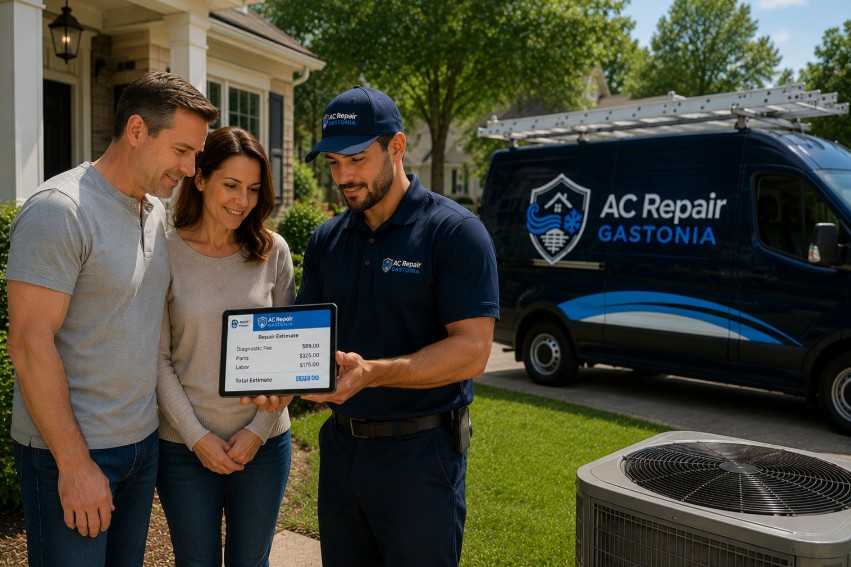
expert showing the esitmate cost of ac repair in cherryville
Get a Written Estimate

The only way to know what your repair will actually cost is to have a technician diagnose the system. You'll receive a written estimate before any work begins — no pressure, no surprises.

Request Estimate Licensed · Certified · Fully Insured

What Cherryville Residents
Actually Ask Before Scheduling

These are the questions that come up most often from Cherryville homeowners — not the generic HVAC FAQ list, but the ones that are specific to where you live and what your system is likely dealing with.

You're based in Gastonia — how far is that from Cherryville, and will that affect my wait time?

Our Gastonia location is approximately 18 miles from Cherryville via US-74 W. The drive under normal conditions runs 25 to 30 minutes. Our average door-to-door response time across all Gaston County calls is around ~47 minutes from when you call to when a technician arrives — that figure includes dispatch time, not just drive time.

Cherryville sits at the far end of our western county route, so same-day availability can depend on current call volume. When you schedule, we confirm your arrival window before ending the call — we don't give you a vague "sometime this afternoon" and leave it at that.

My system is from around 2008. Is it still worth repairing, or should I be planning for replacement?

Systems from 2008 are typically running on R-22 refrigerant, and they're in their late teens in terms of service life. Whether a repair makes sense depends on the specific failure and the overall condition of the equipment — a failed capacitor on an otherwise solid older system is a straightforward repair. A compressor problem on the same system requires a more careful conversation.

The 5,000 Rule is a reasonable starting point: multiply the system's age in years by the estimated repair cost. If the result approaches or exceeds $5,000, a replacement discussion is worth having. A 17-year-old system facing an $800 repair scores 13,600 — that's a conversation we'd have with you honestly rather than just scheduling the work.

Several HVAC companies near me are based in Kings Mountain or Shelby, not Gaston County. Does that matter?

It can, depending on the specifics. A contractor must be licensed in North Carolina to perform HVAC work legally regardless of where their shop is located — so licensing isn't automatically a county-based issue. But Gaston County has its own building code and permit requirements, and a contractor who primarily works in Cleveland or Rutherford County may be less familiar with local permit processes for larger work.

For a diagnostic and repair call, the more practical concern is whether the contractor carries adequate insurance for residential work in North Carolina and whether they can actually respond when they say they will. Kings Mountain is roughly 14 miles from Cherryville by a different route — not significantly faster than our 18-mile route from Gastonia — and our dispatch coverage for Cherryville is a regular western county stop rather than a cross-county exception.

My AC stopped working on a hot afternoon. Before I call, is there anything I should check that might be a quick fix?

A few things are worth checking before making a call, because they occasionally resolve the problem and always help the diagnostic conversation if they don't.

First, check the system breaker in your electrical panel — both the indoor air handler breaker and the outdoor unit breaker. A tripped breaker can cut power to one side of the system without cutting the other, which creates confusing symptoms.

Second, check the float switch on your indoor unit — this is the small safety switch near the drain pan that shuts the system off when the condensate drain is backing up. If the drain pan has visible water in it, that's the likely cause and it will keep tripping until the drain is cleared.

Third, confirm the thermostat is set to Cool (not Fan Only) and that the set temperature is actually below the current room temperature. If none of those apply, the issue needs a technician — and the above information helps when you call.

My house is near Moss Lake west of town. We lose power a few times a year during storms. Can power surges damage the AC?

Yes. Power events can damage AC components — particularly the capacitors and control boards that manage startup and system communication. A sudden voltage surge during restoration after an outage is more likely to cause damage than the outage itself. The compressor and motor capacitors are the most vulnerable components because they're in the electrical path that takes the hit during a surge.

If your system doesn't restart normally after a power restoration event — or restarts but behaves differently than before — that's worth having evaluated. Surge protection at the disconnect or at the electrical panel can reduce this risk for equipment in areas with irregular power. It's not something we install, but it's a relevant discussion to have with an electrician if this is a recurring pattern at your address.

My system is running and cooling the house to the set temperature, but the house still feels humid and uncomfortable. Is that an AC problem?

Humidity control is part of what a properly functioning AC system should provide, and a system that cools to the set temperature but leaves the air feeling clammy is worth examining. The most common causes are oversizing — a system that's too large for the home cools too quickly, satisfies the thermostat before running long enough to dehumidify, and shuts off — or short cycling from a different cause.

A system running on a low refrigerant charge can also produce poor dehumidification — the coil isn't operating at the right temperature to condense moisture efficiently. Homes near Moss Lake and in Cherryville's more wooded areas tend to experience higher ambient humidity, which makes this symptom more noticeable when the system is underperforming on the humidity side.

I haven't had this AC system serviced in about five years. Is there a point where it's been too long and repair no longer makes sense?

Deferred maintenance doesn't make a system unrepairable — it makes the diagnostic picture more complex. A system that hasn't been serviced in five years has likely accumulated coil buildup that's reducing efficiency, may have developed slow refrigerant charge loss through aging connections, and has electrical components that have been cycling without inspection. None of that is automatically fatal, but it does mean the diagnostic process takes longer and may surface more than one issue.

What we don't do is present the backlog of maintenance issues as a list of required repairs before any work starts. The estimate covers what's actually failing and causing the symptom you called about. Separate recommendations may follow, but they're exactly that — recommendations, not conditions for completing the primary repair.

Written Estimate Before Work Begins
Licensed · Certified · Fully Insured
Cherryville, NC · Gaston County

Cherryville and the Communities Around It

Cherryville is one of the western-most points in our service area — we reach it via the US-74 corridor, the same route that connects the western county towns. If you're in Cherryville or anywhere nearby in Gaston County, same-day service is available, the process is the same, and the written estimate comes before any work begins.

Every community in this list receives the same licensed, fully insured service. If your home is in Gaston County, you're in the service area — and you can schedule AC repair with the same confidence as any other homeowner we work with across the county.

Scroll to Top
+1 (704) 469-6658